A Travel Notebook Beyond the Checklist
Record the small details of a trip with a simple notebook format that captures observations without interrupting the experience.
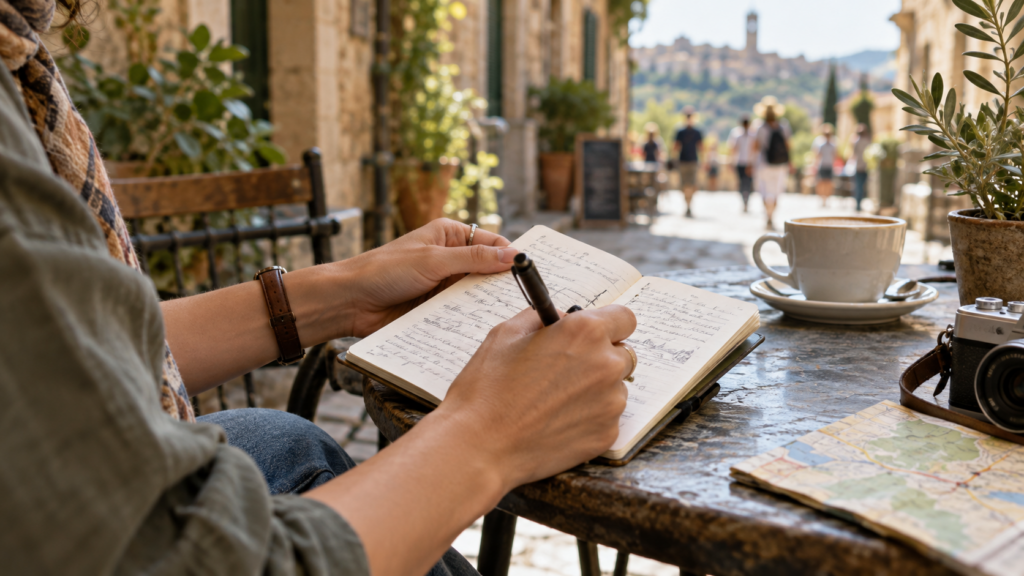
Travel photographs show what stood in front of the camera, but they do not always explain why a moment mattered. A notebook can capture a different layer: a phrase overheard on a train, the arrangement of a market stall, or the feeling of finding a quiet street after a busy afternoon. It need not become a polished journal.
The most useful format is one you will actually return to. A pocket notebook, a few folded pages, or a digital document can all work. Choosing paper is an option for people who enjoy writing away from a screen; choosing a phone may be more practical for someone who wants to carry less.
Record a few specific details
Try three short prompts at the end of a day: what surprised me, what I noticed, and what I want to remember. Answers can be fragments. The exact colour of a door or the sound of a square can be more evocative later than a general statement that the day was enjoyable.
Separate observations from assumptions. You might see a shop closing in the afternoon, but that alone does not explain why it closed. Writing what you actually saw keeps the record honest and leaves room to learn more later. If a guide gives an explanation, note who provided it.
Practical details also have a place. Record the route you took, a useful landmark, or the name of a place you would like to revisit. Avoid storing passwords, payment details, or sensitive personal information in a notebook that could be misplaced. The journal should help preserve the trip without becoming a collection of valuable private data.
Make space for reflection after the trip
During travel, a brief entry is usually enough. Long writing sessions can wait until you have time and interest. The notebook should support attention to your surroundings, not demand that every experience be interrupted so it can be described immediately.
When you return home, read the notes alongside your photographs. Add the context that is still fresh in your memory. You may discover that the most interesting part of a day was not the attraction you planned to see, but the walk, conversation, or unexpected pause beside it.
Decide what should remain private before sharing extracts. Other travellers and people you met may not want their names, conversations, or pictures published. A personal record and a public story have different audiences, and editing for one does not require exposing the whole of the other.
Over time, a travel notebook becomes a record of how you notice places. There is no required length, style, or level of artistic skill. A few precise lines can preserve an experience more effectively than pages written only because you feel a journal ought to be complete.