Looking at One Artwork for Longer
A slower visit to one artwork can reveal composition, materials, and questions that are easy to miss during a crowded gallery itinerary.
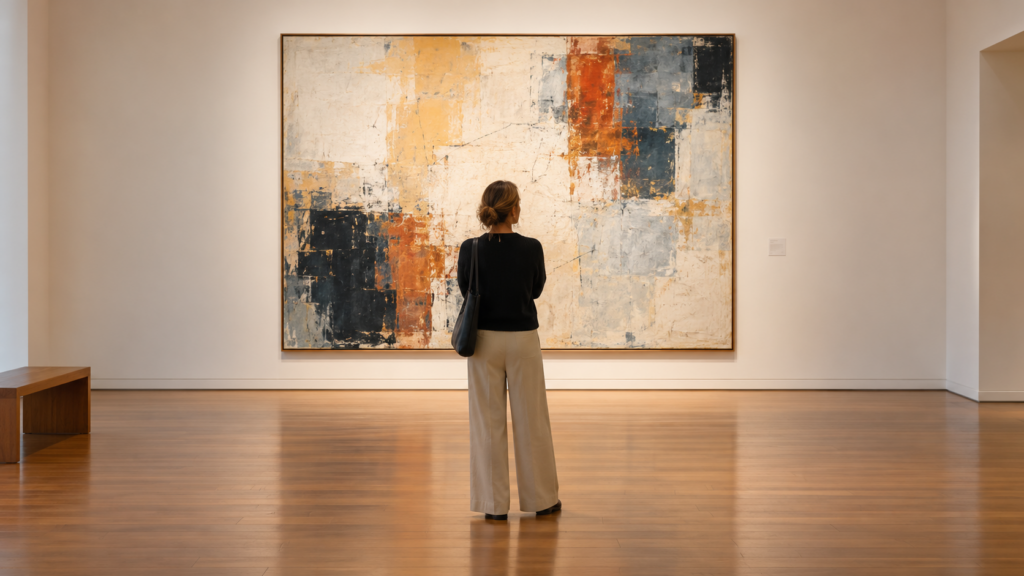
Walking through a gallery can sometimes feel like moving past a series of introductions. You see each work, glance at the label, and continue. Spending longer with a single artwork changes the visit. It gives your attention time to move beyond first impressions and notice choices that are not immediately obvious.
You do not need specialist knowledge to begin. Choose a work that makes you curious, whether because of its subject, colour, material, or something you cannot explain. The goal is to look carefully and form questions, rather than to produce the correct interpretation on demand.
Begin with what is visible
Before reading the label, describe the work to yourself in plain language. What occupies the centre? Where does your eye travel next? Which areas feel busy or quiet? These questions encourage you to look at the actual object instead of searching your memory for an explanation of the artist.
Change your distance when the gallery permits it. From farther away, the overall arrangement may become clearer. Closer viewing can reveal brushwork, surfaces, joins, or details. Respect barriers and instructions, and leave room for other visitors. Careful observation does not require approaching an object more closely than is allowed.
Notice what is absent as well as what is present. A scene may leave out its surroundings; a portrait may direct attention away from the face; an abstract work may repeat a shape with one unexpected variation. These are starting points for questions, not proof that the artist intended a particular message.
Use the label as another layer
Now read the accompanying information. The date, materials, title, and historical context may change your understanding. Compare that information with what you noticed first. A useful label can answer one question while introducing another, which gives you a reason to return to the work.
If the museum offers an audio guide or catalogue, use it according to your interest. You do not have to consume every explanation. One short account can be enough to deepen the encounter while leaving space for your own observations and uncertainty.
Consider writing a few lines after stepping away. Record one detail, one question, and one change in your impression. This is more manageable than trying to describe the entire work. It also makes the visit easier to remember when several rooms begin to blend together.
Seeing fewer artworks may feel unusual in a large museum, but a visit does not need to cover every room. One sustained encounter can provide a satisfying experience. The next time you visit, you can choose a different work and allow the collection to become familiar gradually rather than all at once.